treasure chest
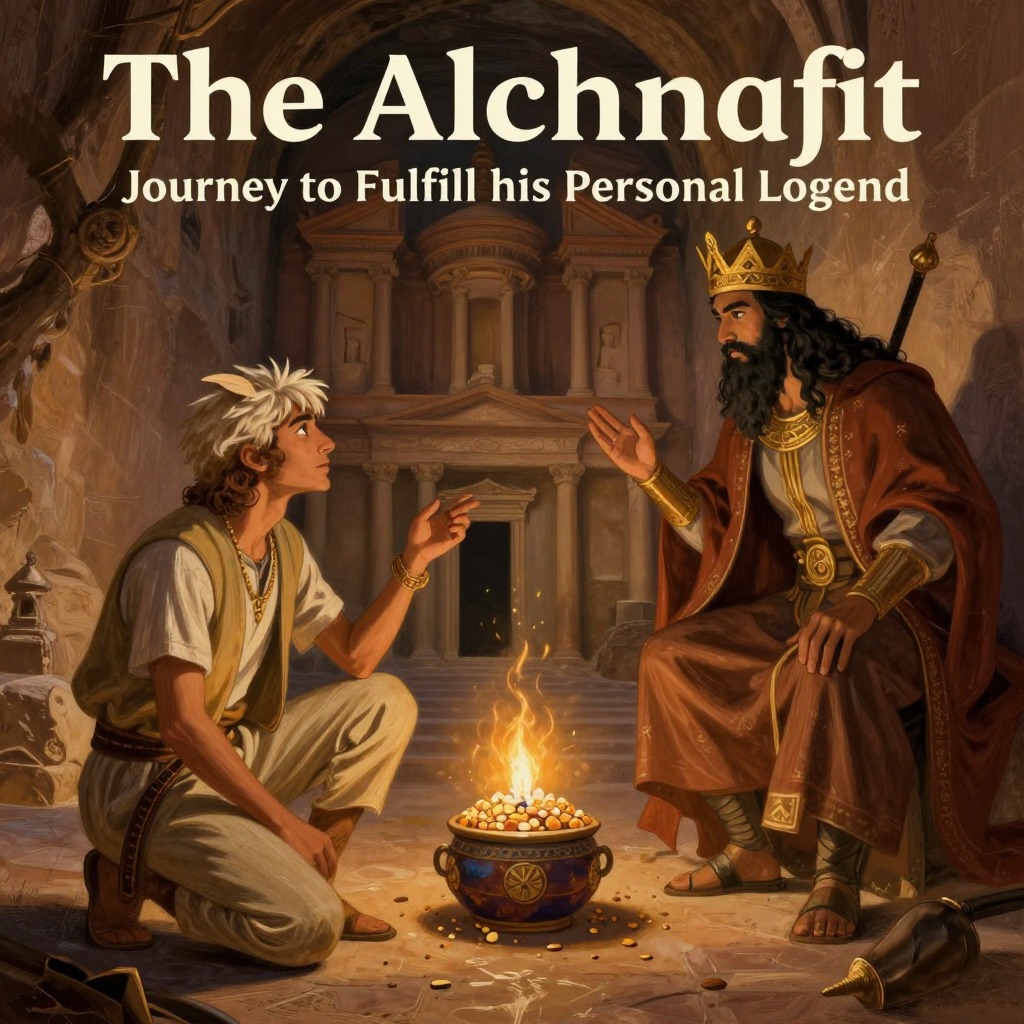
The treasure chest is the material object that Santiago seeks across two continents, yet it is also the narrative device that inverts the entire quest. When Santiago finally unearths it, the chest contains not only Spanish gold coins but also precious stones, gold masks adorned with red and white feathers, and stone statues embedded with jewels—the spoils of a conquest long forgotten by the country. The chest is found not at the Pyramids of Egypt, where Santiago had twice dreamed it would be, but at the abandoned church in Andalusia where his journey began, beneath the sycamore tree that grew from the ruined sacristy. This reversal reveals that the treasure was always at his starting point, and that the purpose of the quest was to transform the seeker, not merely to deliver a prize.
The Nature and Contents of the Treasure
The chest is described as a "chest of Spanish gold coins" containing "precious stones, gold masks adorned with red and white feathers, and stone statues embedded with jewels." These are the spoils of a conquest that the country had long ago forgotten, and that some conquistador had failed to tell his children about. The treasure is thus a relic of Spain's imperial past, a buried history that Santiago, a shepherd who had once dreamed of seeing the world, is uniquely positioned to recover. The chest's contents are not merely wealth but artifacts of cultural memory, objects that link the personal quest to a larger historical narrative. Santiago places Urim and Thummim, the two stones given to him by Melchizedek, into the chest, making them part of his new treasure as a reminder of the old king whom he would never see again.
The Journey to the Treasure
Santiago's pursuit of the treasure is the engine of the entire plot. The quest begins with a recurrent dream: a child transports him to the Egyptian pyramids and tells him he will find a hidden treasure there. This dream is interpreted by the old woman, who demands one-tenth of the treasure, and confirmed by Melchizedek, who extracts one-tenth of Santiago's sheep in exchange for the knowledge that the treasure is near the Pyramids. The journey takes Santiago across the Strait of Gibraltar to Tangier, where he is robbed, then to work for the crystal merchant, then across the Sahara Desert with a caravan, through tribal wars, and finally to the Pyramids themselves. At the Pyramids, Santiago is beaten by refugees from the tribal wars who steal the gold piece he carries. The leader of the attackers, before leaving, reveals that he himself had a recurrent dream of a treasure buried at a ruined church in Spain—the very church where Santiago began. This revelation sends Santiago back across the sea to dig at the base of the sycamore, where he finds the chest.
The Thematic Significance of the Treasure
The treasure chest is the physical proof of the novel's central philosophy: that the universe conspires to help those who pursue their Personal Legend. Santiago reflects that "life really is generous to those who pursue their destiny." The treasure is not merely gold but a symbol of the wisdom gained through the journey. The alchemist had told Santiago that "before a dream is realized, the Soul of the World tests everything that was learned along the way," and that "every search begins with beginner's luck and ends with the victor's being severely tested." Santiago's beating at the Pyramids is that final test, and the revelation of the treasure's true location is the reward for having passed it. The chest also fulfills the promise made to the old woman, as Santiago remembers he must give her one-tenth of his treasure. The treasure thus completes the cycle of the quest: it validates the omens, the mentors, the sacrifices, and the love that Santiago found along the way.
The Treasure as a Symbol of the Journey
The treasure chest is ultimately less important as an object than as a confirmation of the journey's meaning. Santiago had already learned the Language of the World, found love with Fatima, and understood the Soul of the World before he ever laid eyes on the chest. The alchemist had told him that "when you possess great treasures within you, and try to tell others of them, seldom are you believed." The chest is the external treasure that mirrors the internal one Santiago has already acquired. When he finally digs it up, he laughs at the Pyramids, which "seemed to laugh at him, and he laughed back, his heart bursting with joy." The treasure is not the goal but the byproduct of a life lived in pursuit of destiny. Santiago's final act is to place Urim and Thummim in the chest, acknowledging that the stones—and the king who gave them—are as much a part of his treasure as the gold.